
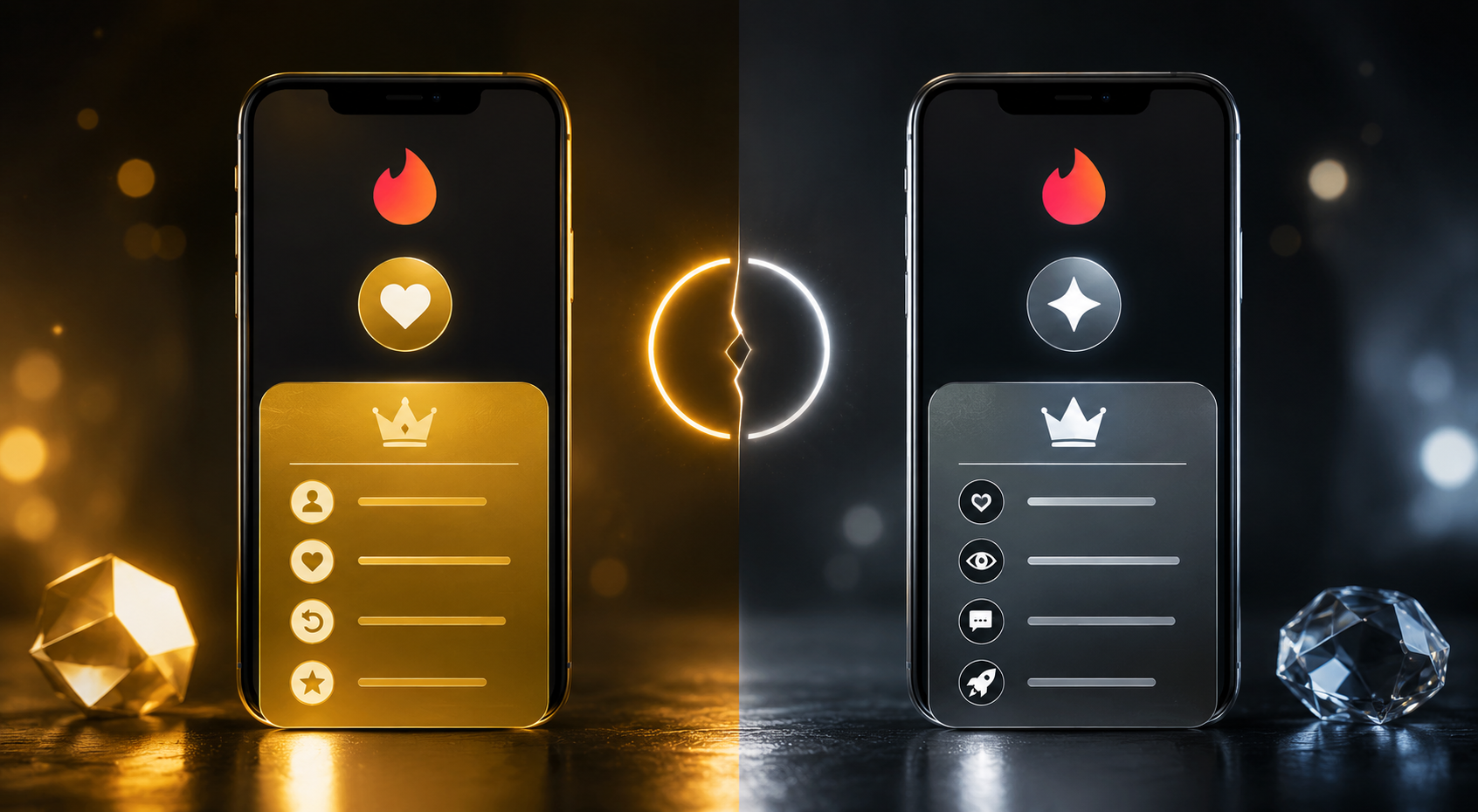
Bottom line: Tinder Gold is the sweet spot for most users — it unlocks the game-changing “See Who Likes You” feature at a reasonable price. Tinder Platinum makes sense only if you’re in a major city and need algorithmic priority to stand out. Read on for the full breakdown.
Table of Contents
- Quick Overview
- Pricing in 2026
- Full Feature Comparison
- Tinder Gold: Deep Dive
- Tinder Platinum: Deep Dive
- Who Should Choose Each Plan?
- Real Results & User Data
- Final Verdict
- Frequently Asked Questions
1. Quick Overview: What Are These Plans?
Tinder’s subscription model is layered into three paid tiers: Plus, Gold, and Platinum. If you’ve already moved past the free version — with its limited daily swipes, no rewinding, and no filters — the real decision for most users lands squarely between Gold and Platinum.
In 2026, Tinder remains one of the most dominant dating platforms globally, with hundreds of millions of registered users. As the market grows more competitive, the app continues to lean harder into its premium tiers. Understanding exactly what you’re paying for — and whether it actually changes your results — has never been more important.
If you’ve ever wondered whether investing in a paid dating app is worth it at all, our article on 5 key differences between free vs. paid dating apps gives a great foundational perspective before committing to any plan.
Tinder Gold — ~$39.99/month
- See Who Likes You (full grid)
- Unlimited Likes
- Daily Top Picks (4–10 curated profiles)
- Passport — swipe anywhere in the world
- Advanced Discovery filters
- No ads, Rewind, monthly Boost
Best for: Urban daters who want efficiency.
Tinder Platinum — ~$49.99/month
- Everything in Gold, plus:
- Priority Likes (algorithmic visibility boost)
- Message Before Matching (140-char note with Super Likes)
- Photo performance insights
Best for: Highly competitive markets and power users.
2. Tinder Gold vs Platinum: Pricing in 2026
One of the most important — and most overlooked — aspects of Tinder’s subscription model is that pricing is dynamic. The price you see is not necessarily the price your friend sees.
Tinder adjusts its rates based on multiple factors: your age, geographic location, device, how long you’ve had the account, and whether you’ve ever subscribed before. Users under 28 typically see significantly lower rates, while users over 30 often fall into higher pricing brackets.
| Billing Period | 🥇 Tinder Gold | 💎 Tinder Platinum |
|---|---|---|
| Monthly (1 month) | ~$39.99 | ~$49.99 |
| 6-month plan (per month) | ~$23.33 | ~$29.99 |
| Weekly plan | ~$18.99/wk | ~$24.99/wk |
| Users under 28 (estimate) | ~$20–$28/mo | ~$25–$35/mo |
⚠️ Dynamic Pricing Warning: The prices above are estimates based on standard US market rates. Your actual price may differ significantly. Always check the in-app pricing screen before committing. If you’ve subscribed before and canceled, Tinder may offer lower re-engagement prices.
The price gap between Gold and Platinum is roughly $10/month on a standard plan. Over a 6-month subscription, that’s an extra $60 — a meaningful amount, especially if the exclusive Platinum features don’t generate tangible results for your specific situation.
3. Full Feature Comparison: Gold vs Platinum
Below is a comprehensive side-by-side breakdown of every feature available in each tier.
| Feature | 🥇 Gold | 💎 Platinum |
|---|---|---|
| Unlimited Likes | ✅ | ✅ |
| See Who Likes You (grid) | ✅ | ✅ |
| Top Picks (4–10 daily) | ✅ | ✅ |
| Passport (change location) | ✅ | ✅ |
| Advanced Discovery Filters | ✅ | ✅ |
| No Ads | ✅ | ✅ |
| Rewind Last Swipe | ✅ | ✅ |
| Monthly Free Boost | ✅ | ✅ |
| Super Likes (weekly) | 3/week | 3/week |
| Read Receipts | ✅ | ✅ |
| Priority Likes (algo boost) | ❌ | ✅ |
| Message Before Matching | ❌ | ✅ |
| Photo Performance Insights | ❌ | ✅ |
The key insight: Platinum is essentially Gold with two exclusive additions — Priority Likes and Message Before Matching. Everything else is identical. Whether those two features justify the price jump is the real question this article answers.
4. Tinder Gold: Everything You Need to Know
Tinder Gold has been around since 2017 and remains the most popular paid tier on the platform. Its main draw has always been the same: letting you see exactly who has already swiped right on you.
The “See Who Likes You” Feature
This is the headline feature of Gold — and for good reason. Instead of swiping blindly and hoping for a match, you get a full grid showing every user who has already liked your profile. You can match with them instantly by tapping their photo.
The efficiency gain is real. Rather than burning through daily swipes into the unknown, you’re working with people who have already expressed interest. In large cities with active user bases, this grid can fill up quickly, creating a dramatically different experience.
Think of it this way: Gold is an inbound tool. It processes the interest that’s already coming your way more efficiently. If you already have good profile photos and an engaging bio, Gold will help you capitalize on it.
💡 Pro Tip: Gold’s “See Who Likes You” feature is most powerful when your profile is already well-optimized. Before upgrading, ensure your photos are high quality and your bio is genuine and specific. A full “Likes” grid is only valuable if the profiles in it are people you’d actually want to match with.
Top Picks
Every day, Tinder’s algorithm curates 4–10 “Top Picks” — profiles it believes are highly compatible with you based on your swiping behavior, shared interests, and other data signals. These are usually above-average profiles in terms of engagement, making this useful for finding quality matches quickly rather than just browsing volume.
Advanced Discovery Filters
Gold unlocks filters beyond the basic distance and age sliders. You can filter by education level, communication style, relationship goals, and relationship type — helping you cut through the noise in oversaturated markets.
Pros and Cons of Tinder Gold
✅ Pros:
- Dramatically reduces time spent swiping
- Shows real inbound interest immediately
- Top Picks improves quality of profiles seen
- Better value than Platinum for most users
- Passport enables travel or relocation scouting
❌ Cons:
- No algorithmic visibility boost
- Can’t message before matching
- Useless if your profile is not optimized first
- Expensive for casual or rural users
- Likes grid will be empty if profile needs work
5. Tinder Platinum: Is the Upgrade Worth It?
Tinder Platinum is the top subscription tier at approximately $49.99/month. It includes everything from Gold plus two exclusive features that no other tier offers.
Priority Likes: The Visibility Engine
When you swipe right on someone as a Platinum subscriber, your like gets prioritized in their queue. Your profile appears earlier in that person’s card stack, before non-Platinum users.
In cities like New York, Los Angeles, São Paulo, or London — where someone’s “Likes” queue can contain hundreds of profiles — this matters enormously. Without priority, your profile might not surface for days. By then, the person has already matched and started conversations with others.
Platinum is an outbound tool. Unlike Gold, which processes incoming interest, Platinum actively pushes your profile outward to more people. It’s designed for users who are struggling with visibility, not just efficiency.
Message Before Matching: First Impressions in 140 Characters
This is arguably the most unique feature on the platform. When you send a Super Like as a Platinum subscriber, you can attach a short message — up to 140 characters — that the recipient sees before they’ve even swiped on you.
According to Tinder’s own data, using this feature with a relevant, personalized message boosts your match rate by approximately 25% compared to a standard Super Like. The key word: “personalized.” Generic openers like “Hey, you’re cute” are unlikely to move the needle.
⚠️ Important Caveat: The Message Before Matching feature can backfire. Users who send generic, pushy, or inappropriate messages with their Super Likes report that it actually reduces their match rates. Quality of the message matters enormously. If you can’t write a compelling 140-character opener, this feature may hurt more than it helps.
Photo Performance Insights
Platinum subscribers get data showing which of their profile photos are generating the most interest. This helps you refine your photo lineup based on actual engagement data rather than guesswork — a genuinely useful optimization tool.
Pros and Cons of Tinder Platinum
✅ Pros:
- Real algorithmic visibility boost
- Message Before Matching can help you stand out
- +25% match rate on Super Likes when used well
- Photo insights helps ongoing profile optimization
- Best option for high-competition urban markets
❌ Cons:
- Most expensive tier (~$50/month)
- Priority boost effect fades over time
- Exclusive features are marginal for most users
- Poor messages can actively hurt your results
- Overkill for small cities or casual daters
6. Who Should Choose Gold — and Who Should Go Platinum?
The right tier depends heavily on your situation: where you live, how active you are on the app, and what specific problem you’re trying to solve.
Choose Gold if…
- You’re in a mid-to-large city
- You already get some matches on the free version
- You want to swipe more efficiently
- You’re tired of guessing who liked you
- You travel or plan to relocate
- Budget is a consideration
- You’re dating after 40 and want quality filters
Choose Platinum if…
- You’re in NYC, LA, London, São Paulo, or similar
- You get almost zero matches currently
- You’re highly active on the app every day
- You’re confident writing strong, creative openers
- You’ve already fully optimized your profile
- You need algorithmic visibility, not just efficiency
- You want every possible competitive edge
There’s an important philosophical difference between the two plans that sums it up perfectly: Gold assumes you’re already attractive to users; Platinum attempts to make you visible to more of them. If your likes grid is empty under Gold, adding Platinum won’t fix an underlying profile issue — it will just put a mediocre profile in front of more people faster.
Before investing in either plan, it’s also worth considering whether you might be falling into patterns that reduce the overall quality of your dating app experience. Our article on 7 strategies to overcome dating app addiction is a useful read for anyone who feels the app is consuming more mental energy than it should.
7. Real Results: Does the Upgrade Actually Work?
This is the question everyone wants answered. The honest answer: it depends on your profile quality and your location.
What the Data Shows for Gold
Gold’s core benefit — the “See Who Likes You” grid — is widely recognized as the single most valuable feature Tinder offers at any paid tier. For users in active urban markets, the grid can contain dozens or even hundreds of potential matches. The time savings alone justify the cost for frequent users.
Gold’s Top Picks and advanced filters add a quality layer on top of efficiency, making it particularly effective for users who are serious about finding compatible matches — not just accumulating swipes.
What the Data Shows for Platinum
One documented user experiment showed a jump from 2–3 matches per day to 15–18 matches per day in the first week of Platinum. However — critically — the effect faded significantly over the following weeks, settling back closer to baseline. This suggests that Platinum’s boost is most powerful immediately after subscribing, possibly as part of Tinder’s new-subscriber promotional window.
Independent user data across multiple sources suggests Platinum delivers roughly 15–25% higher match rates compared to Gold in dense urban areas — but nearly no measurable improvement in smaller markets where the user pool is already limited.
💡 Expert Tip: If you’re going to try Platinum, do it strategically. Spend the first two weeks maximizing activity — swipe often, use all your Super Likes with carefully crafted messages, and engage with matches quickly. The algorithmic benefit appears to be front-loaded.
What Neither Plan Can Fix
Both Gold and Platinum share one fundamental limitation: they cannot fix a poorly optimized profile. Bad photos, no bio, and generic openers are invisible to Tinder’s subscription algorithm. The platform’s own data consistently shows that profile quality is the dominant factor in match rates — not subscription tier.
Beyond results, it’s also essential to stay aware of risks in the online dating landscape. Staying informed about common dating app scams and how to spot them is an essential part of safe, effective online dating — regardless of which tier you’re on.
8. Final Verdict
For the vast majority of Tinder users, Gold is the right choice. The ability to see who already likes you transforms the experience from a blind guessing game into a targeted, efficient process. The additional filters and Top Picks make it a genuinely useful tool for anyone dating seriously in a mid-to-large city.
Platinum is only worth the extra ~$10/month if you are:
- In a major metropolitan area with thousands of active users
- Already getting results with Gold and want to push further
- Capable of writing compelling 140-character openers that will actually improve your Super Like conversion rate
If you’re starting from zero — new account, fresh photos, first time paying — start with Gold for at least one month. Measure your results. If you’re satisfied with the quality and volume of matches, stay there. If you’re in a market so competitive that you feel invisible even with Gold, then — and only then — consider the Platinum upgrade.
It’s also worth noting that if you’re over 40, the calculus may be slightly different. Dating apps can be a genuinely effective tool for this demographic when used strategically. Our piece on why dating apps do work after 40 explores why the subscription investment often pays off more meaningfully for mature daters who bring clearer intentions to the process.
9. Frequently Asked Questions
Can I switch between Gold and Platinum mid-subscription?
Yes. You can upgrade from Gold to Platinum at any time through the app’s subscription settings. Tinder will typically prorate the remaining days of your current plan. However, downgrading mid-cycle may not result in a refund — always check the current terms in your region before making a change.
Does Tinder Gold boost your profile in the algorithm?
No. Gold does not provide any algorithmic visibility boost in other users’ card stacks. Your profile appears just as often (or infrequently) as it would on the free version. Only Tinder Platinum — through its Priority Likes feature — actively pushes your profile earlier in other users’ queues. Separate Boost purchases are the other way to gain temporary algorithmic visibility.
Is Tinder Platinum worth it in a small city or rural area?
Almost certainly not. Platinum’s core advantage — priority placement in a large, competitive queue — has little effect when the total user pool in your area is small. In rural areas or small towns, the daily active user count may already be low enough that your profile is surfacing to nearly everyone available. In this case, even Gold may be overkill.
How does Tinder pricing differ by age?
Tinder uses dynamic pricing tied in part to age. Users under 28 tend to see lower prices for all tiers. Users over 30 typically see standard or above-standard rates. This policy has faced legal challenges in some jurisdictions, and pricing practices continue to evolve — always check your in-app pricing directly.
Can I cancel my Tinder Gold or Platinum anytime?
Yes. Subscriptions can be canceled at any time through the App Store, Google Play, or Tinder’s website, depending on how you subscribed. Canceling stops future billing but does not refund the current billing period. Your premium features remain active until the subscription period ends.
Is it safe to give Tinder my payment information?
Tinder processes payments through Apple’s App Store and Google Play, meaning your credit card is handled by those platforms rather than directly by Tinder. That said, always apply standard digital hygiene: use a dedicated card for subscriptions, monitor your statements, and be aware of auto-renewal settings. For a broader look at staying safe on dating platforms, see our guide on common dating app scams.