
Updated for 2026 | 12-minute read
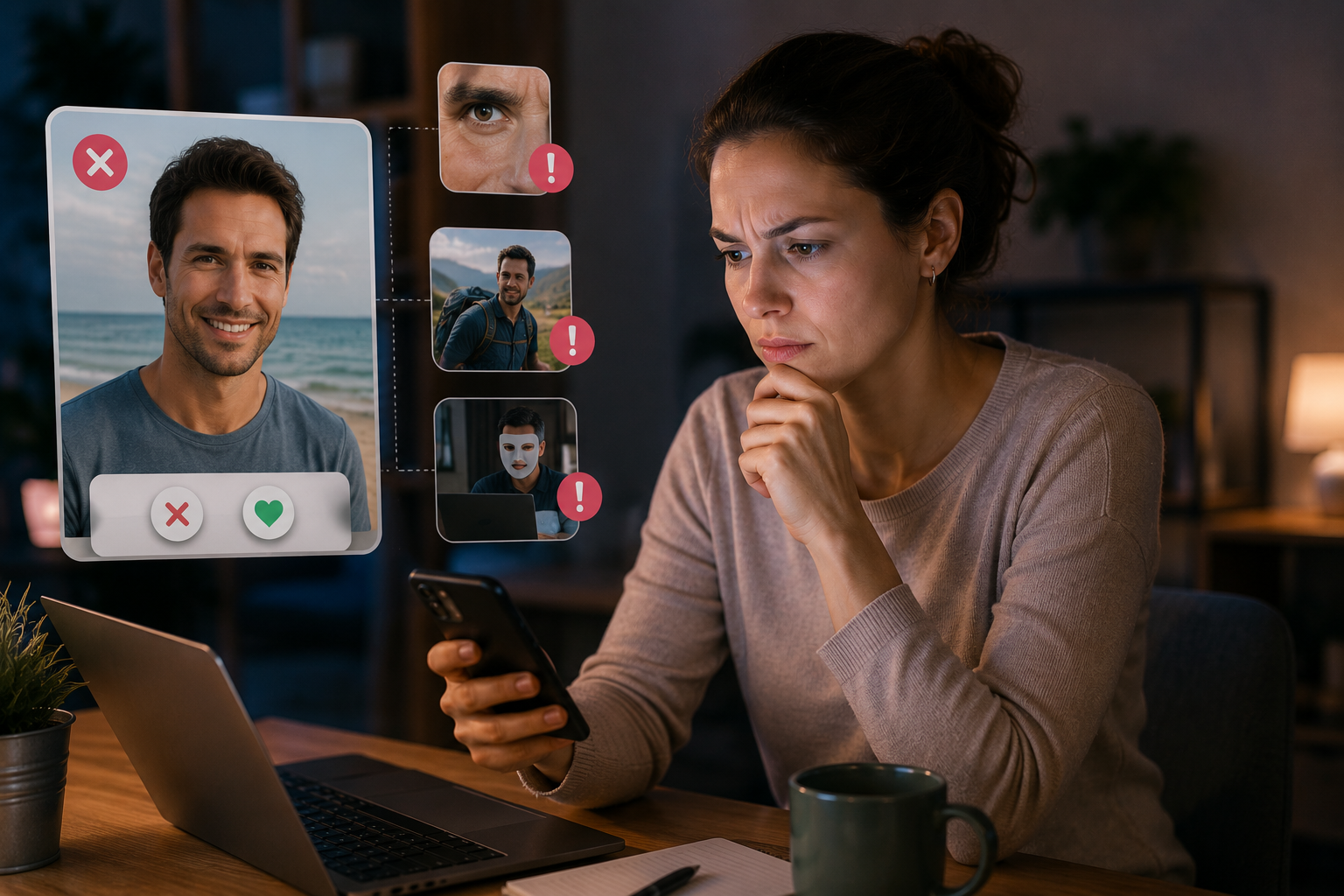
You match with someone who seems almost too perfect — great photos, charming messages, and a compelling story. But before you invest your time, emotions, or money, there’s one critical question you need to ask: is this person even real?
Catfishing — creating a fake online identity to deceive someone, typically for emotional manipulation or financial gain — has grown into one of America’s most damaging forms of online fraud. According to the FTC’s Consumer Sentinel Network, consumers reported losing $1.16 billion to romance scams in just the first nine months of 2025 alone, a 22% jump compared to the same period in 2024. And because most victims never file a formal report, the actual number of people hurt is likely far higher.
The good news? Fake profiles follow predictable patterns. Once you know what to look for, spotting them becomes much easier. This guide breaks down every major red flag — from suspicious photos to scripted conversations — so you can protect yourself before you get catfished.
Why Fake Dating Profiles Are Everywhere in 2026
The scale of the problem is staggering. Research compiled from FBI, FTC, and academic sources estimates that roughly 10% of all online dating profiles are fraudulent or fake. A Pew Research Center survey found that about 3 in 10 U.S. adults who have used online dating say they’ve encountered profiles they believed were fake or misleading — and among those aged 18–29, that figure rises to 42%.
What’s changed in recent years is the technology behind the deception. AI image generators like Midjourney and others have made it trivially easy to create a photorealistic face that has never existed — and because these images are entirely new, traditional reverse image searches often return nothing. The FBI has explicitly warned that AI has made catfishing easier than ever before, and in 2025 alone, victims lost over $19 million to scams with a confirmed AI-generated profile component.
Social media has also become a primary launchpad for scammers. According to fresh FTC data from April 2026, nearly 60% of people who reported losing money to a romance scam in 2025 said it started on a social media platform — often Facebook, Instagram, or Facebook Dating. Scammers tailor their approach based on what victims post publicly, making the deception feel personal and credible from the very first message.
Red Flag #1: The Photos Look Too Perfect
The first thing most people notice about a dating profile is the photos — and photos are also where most fakers slip up.
Watch for these specific warning signs:
- Studio-quality shots with no casual context. Real people have candid snapshots, group photos, and images from everyday life. If every single photo looks like a magazine shoot, something is off.
- No group photos whatsoever. AI image generators struggle to produce coherent multi-person scenes. A profile with only solo portraits and zero social context is a significant red flag.
- Odd physical details. Current AI still sometimes stumbles on hands, teeth, ears, and hair at the edges. Look closely — asymmetrical features, extra fingers, or backgrounds that blur unnaturally near the face are telltale signs.
- Inconsistent lighting. In altered or composite images, the light source on the person’s face often doesn’t match the background. If the lighting feels “off,” trust that instinct.
- Only one or two photos. Legitimate users almost always have a variety of images showing different settings and time periods. A single perfect photo is a classic scammer playbook move.
If the photos pass the eye test but still feel suspicious, do a reverse image search. Upload the photo to Google Images, TinEye, or a specialized tool like Social Catfish. If that same image appears on stock photo sites, unrelated social media accounts, or multiple profiles with different names, you’ve found a fake. Note, however, that AI-generated photos are unique and won’t appear in reverse searches — which is why the visual inspection checklist above matters even more in 2026.
Red Flag #2: The Bio Is Vague, Generic, or Inconsistent
A fake profile’s written content is often its weakest point. Scammers operate dozens of profiles simultaneously, which means they write bios and messages that are intentionally vague — applicable to almost anyone.
Common bio red flags include:
- No specific details. Real people mention their neighborhood, specific hobbies, their actual job title, or something memorable about their life. A bio that says “I love traveling, music, and good food” tells you nothing — and is often copy-pasted.
- Contradictions. Ask the same casual question twice, days apart. Fabricated identities are hard to maintain consistently. If the story changes — the city they grew up in, how many siblings they have, where they work — take note.
- Too-perfect life narrative. Scammers often construct an aspirational identity: successful professional, widowed with one child, stationed overseas as a military officer or international engineer. These personas are designed to trigger sympathy and admiration simultaneously.
- Grammar and syntax that doesn’t match their claimed background. Someone who claims to be born and raised in Dallas but writes in patterns consistent with a non-native English speaker deserves a closer look.
Red Flag #3: They Move Fast — Very Fast
Legitimate relationships develop gradually. Catfishers can’t afford patience; they need to build emotional dependency quickly before you start asking too many questions.
If someone you matched with three days ago is already using terms like “I’ve never felt this way about anyone,” “you’re the one I’ve been waiting for,” or “I think I’m falling for you” — that’s a manipulation tactic, not genuine connection. Psychologists call this love bombing, and it’s a signature move in romance scam playbooks.
Other escalation red flags:
- Pushing to move the conversation off the app (to WhatsApp, Telegram, or text) very quickly
- Asking deeply personal questions about your finances, family situation, or loneliness early on
- Expressing jealousy or possessiveness before you’ve even met
The average catfishing scam lasts about 146 days before discovery. The emotional investment built during that time is precisely what makes victims willing to send money when the “crisis” arrives.
Red Flag #4: They Always Have an Excuse Not to Video Chat
This is one of the most reliable tells. If someone is genuinely interested in you and their photos are real, a 5-minute video call costs them nothing.
Common excuses scammers use to avoid video:
- Their camera is broken
- They’re in a location with poor internet (often claimed to be abroad — working on an oil rig, deployed in the military, or doing humanitarian work overseas)
- They’re “shy” about video
- They keep rescheduling and canceling
If someone has refused a live video call after multiple requests over multiple weeks, treat the profile as fake. A real person who is genuinely interested will find a way to appear on camera.
When you do get on a video call, pay attention: some sophisticated scammers now use deepfake filters in real time. If the video feels laggy, the face seems slightly off, or the person always has a reason their camera quality is poor, remain skeptical.
Red Flag #5: Their Social Media Footprint Is Thin or Nonexistent
Most American adults have some traceable online presence — LinkedIn, Facebook, Instagram, even just old forum posts. A real person with a genuine identity leaves digital traces over years.
When you meet someone new on a dating app, it’s completely reasonable to search for them before investing emotionally. Search their full name, their username, their claimed employer, and their city. If you find nothing — no LinkedIn, no tagged photos, no mentions anywhere — that absence is itself suspicious.
Signs of a manufactured social media presence:
- Account created recently (check the “joined” date on Twitter/X or the earliest post dates on Facebook)
- Very few posts and followers, but lots of generic-looking profile photos
- Friends list that looks unusual — all foreign accounts, all created at similar times, or zero mutual friends with anyone
A legitimate match should be verifiable. If they can’t be found at all, ask yourself why.
Red Flag #6: The “Emergency” That Requires Money
This is the endgame of almost every catfishing scam. After weeks or months of emotional investment, the crisis arrives.
Common scenarios scammers use to request money:
- Medical emergency — they or a family member is in the hospital
- Stranded abroad and need money for a flight home
- Military member claiming they need funds to take leave and visit you
- Business deal that went wrong and they need a temporary loan
- Customs or legal fees to retrieve a package they’re “sending you”
A critical point the FTC emphasizes: members of the U.S. armed forces never have to pay out-of-pocket for medical care, meals, leave requests, or to receive packages. Anyone claiming otherwise is a scammer.
Once money changes hands — whether via wire transfer, gift cards, Zelle, Venmo, or cryptocurrency — recovery is nearly impossible. Cryptocurrency in particular is favored by scammers precisely because transactions are irreversible.
If you’ve already been scammed, report it to the FTC at reportfraud.ftc.gov, the FBI’s Internet Crime Complaint Center at ic3.gov, and your dating app’s safety team.
How to Verify a Dating Profile: A Step-by-Step Checklist
Before getting emotionally invested in someone you’ve met online, run through this verification process:
Step 1 — Reverse image search their photos Upload to Google Images, TinEye, and Social Catfish. Look for the same image under different names or on stock photo sites.
Step 2 — Search their name and username Use Google, LinkedIn, Facebook, and Instagram. A real person should be findable.
Step 3 — Check their social media account age and activity Old accounts with organic history are a positive sign. Brand-new accounts with suspiciously polished photos are not.
Step 4 — Request a video call within the first week No excuses. Any genuine interest should survive a short video introduction.
Step 5 — Ask specific, verifiable questions What neighborhood did they grow up in? What’s their company’s actual name? Can you find it online? Inconsistencies reveal fabrication.
Step 6 — Trust your gut on the pace If the relationship is moving at an emotionally overwhelming speed, slow it down. Scammers lose interest when victims stop accelerating toward attachment.
AI and Deepfakes: The New Frontier of Catfishing
The catfishing landscape has shifted dramatically with the rise of generative AI. Beyond static profile photos, scammers in 2026 are deploying AI tools to:
- Generate entirely synthetic identities with no traceable origin
- Use real-time deepfake filters during video calls to impersonate an attractive person
- Automate initial conversations with AI chatbots that pass for human long enough to build interest
- Create fake social media histories with consistent AI-generated posts and photos
Norton’s 2025 Cyber Safety Insight Report found that less than half of online daters can tell the difference between a real dating profile photo and an AI-generated one — which underscores why the behavioral red flags (refusing video calls, moving too fast, vague bios, emergency money requests) matter just as much as the visual ones.
No AI detection tool is foolproof. The best defense remains a combination of technical verification and healthy skepticism about the pace and intensity of new online connections.
Who Gets Targeted — and Why It’s Not About Being “Naive”
Romance scam victims span every demographic, education level, and income bracket. The FTC’s data shows that adults aged 20–29 actually reported losing money in 44% of romance scam cases — a higher rate than older age groups. Meanwhile, older adults (60+) reported losing $2.4 billion to fraud in 2024, with romance scams among the top categories.
Scammers are professionals who follow refined scripts. They adjust their approach based on the victim’s profile — tailoring a different pitch for a 25-year-old single woman versus a 55-year-old recently divorced man. Falling for a well-executed catfishing operation is not a sign of stupidity; it’s a sign that the scammer did their job.
Understanding this dynamic — that you can be vulnerable without being naive — is what allows people to stay open to genuine connection while maintaining appropriate caution.
Staying Safe Without Giving Up on Online Dating
Dating apps remain one of the most common ways Americans meet romantic partners, and the vast majority of interactions are legitimate. The goal isn’t paranoia — it’s informed awareness.
A few practical habits that make online dating significantly safer:
- Use platforms with identity verification features (Bumble’s photo verification, for example, has reportedly blocked 95% of fraudulent accounts in early testing)
- Never send money to someone you haven’t met in person, regardless of how compelling the story
- Tell a trusted friend or family member who you’re talking to online — outside perspective often catches what attachment blinds us to
- Report suspicious profiles immediately; every report helps platforms improve their detection algorithms
If you want to understand more about the scam tactics operating on today’s apps, our article on 7 Common Dating-App Scams — How to Spot Them and Stay Safe walks through the most prevalent schemes in detail.
And if you find yourself checking your apps compulsively even when the experience is draining you emotionally, it may be worth reading about 7 Strategies to Overcome Dating App Addiction — the same psychological hooks scammers exploit also make healthy app use harder to maintain.
Final Thoughts
Catfishing works because it exploits something real and human: the desire for connection. The scammers understand this, which is why their tactics are so emotionally sophisticated.
But so is your instinct. If something feels off — the photos seem too perfect, the relationship is escalating too fast, or the excuses for not meeting keep piling up — those feelings deserve your attention.
The best protection against getting catfished is a combination of practical verification tools, knowledge of common tactics, and the confidence to slow things down when a connection feels pressured. Real people who genuinely want to know you will respect that.
Stay curious, stay connected — and stay safe out there.
Sources: Federal Trade Commission (FTC), FBI Internet Crime Complaint Center (IC3), Pew Research Center, Norton Cyber Safety Insight Report 2025, Comparitech Romance Scam Analysis 2024–2025.